Wednesday, May 19, 2021

Hippo Attack


 He did not realize a hippopotamus was under the muddy water when he put out his canoe today. Without warning the giant beast was churning waves toward him. Within seconds the hippo had him in its jaws. 


He was struggling to breath in the stretcher there in front of me. His t-shirt was dripping in blood. The left chest was sunken, flailing as he inhaled. 


I placed a chest tube and packed the wound. Air expelled from his chest cavity bubbled in our make-shift water seal. He breathed a bit more easily and his oxygen saturation’s improved. His low blood pressure resolved with the additional assistance of blood transfusions. He will have a rough road to recovery but should make it. 


Friday, March 12, 2021

Thumbs Up


This 4-year-old boy came after vomiting everything he ate for a month. In the previous week he had not even been able to keep down any water. He finished treatment for malaria and typhoid without improvement. He had a huge scar on his abdomen from an umbilical hernia repair in the capitol a year before so I suspected an adhesive bowel obstruction. Strangely he was not very distended or in much pain. He simply threw up every single ounce of what he put in his mouth. Ultrasound showed nothing notable. We offered the family an operation. We explained we may not find something we can fix with surgery.  

Our super smart nurse assistant predicted it would be a negative laparotomy. When we opened the abdomen there were no adhesions or small bowel dilation. There was nothing abnormal about the intestines. I told our nurse he won. Nothing we could help with. Disappointing!

I kept looking and praying we could find something. The stomach seemed really big. The anesthetic we often start with for children is ketamine alone. This kid was requiring some gentle bag masking with anesthesia. They tried, but couldn’t pass a tube in the nose to decompress the stomach. I kept examining the stomach. The pylorus, where the stomach meets the beginning of the small bowel, was hard. It seemed extremely narrow. We could not seem to force any air from the now giant stomach past this point into the small bowel. This was hard and fibrotic, unlike the common pyloric stenosis seen in babies. 

I decided to open the connection that seemed blocked with scar tissue (Heineke-Mikulicz Pyloroplasty). This is a delicate procedure in a 4 year-old. I was sweating not only because it was 80 degrees F. If what I was doing to him did not heal adequately, within a couple days the stomach juices would leak outside the intestine. If that happened in our circumstances here in Chad, the child would die. 


We watched pensively over the next several days. He was doing well and we let him drink liquids. He would cry whenever he saw me, but enjoyed drinking with no vomiting. He’s eating liquid cereal now without vomiting for the first time in over a month. He’s going home a week after his operation. I’m ecstatic. 

He and his family allowed us to take photos. Then his family talked to him and he did something I have never seen someone do here. Picture below.


Sunday, January 10, 2021

War Breaks Out


 “Doctor, we have trauma patients for you to see.” I run to Urgence. 
What happened? “The nomadic cattle herders are fighting against the crop farmers. This man was shot in the neck with an arrow. He pulled the arrow out. He says it hurts to breath and swallow.” 

I feel his neck. Crépitus like rice crispies popping is under my fingertips. Great. I should explore this zone II neck injury in the OR.

Oh there is another patient, an arrow penetrated his left chest...and oh, another patient is on the way. 

More of the story comes out. A wonderful man named Solomon cooks lunch for us during the week. His nephew went to visit family out in a village. Suddenly, the sesame stalks they had harvested were on fire. The nephew ran out to see what was happening. He was unarmed. The nomadic cattle herders were waiting for him and after nailing him with an arrow they ran to him and broke his neck. Villagers are fighting back at the Fulani cattle herders and more people have joined the violence on both sides. 


This man with the arrow in his left chest has developed a pneumothorax. 

We place a chest tube. It has been fun to help the local Chadian docs learn procedures and in this case one did it without my help for the first time. We have no chest tube atriums so I jerry rig a foley bag tube into a container of water to act as a one-way valve water seal. 


The military is out in the bush now. I have to be careful what I write. (If you know, you know.) I’ll just say that they used weapons not available to others. They  protected the Fulani. I will admit the Fulani are a beautiful Muslim people. My friends and I here love them. 

Now for the neck injury. I intubated him in the OR to secure the airway while attempting endoscopy. Too much edema and blood to see well. I opened the neck with the incision I’m most comfortable with for carotid artery surgery. The arrow had penetrated the thyroid cartilage right into the posterior larynx.

No problem right. Just like every other penetrating laryngeal injury I have seen... Just kidding. In 8 years of taking call in busy trauma centers I’ve never dealt with this. Even if I had, an ENT specialist would have been responsible. Here there is no ENT specialist available to the common villager. 

(Figure shows instrument pointing to the hole in the thyroid cartilage of the larynx)

We repair the injury in 3 layers and place a drain. I pray that the repair will heal. If not, he will have saliva pouring out his neck for a long time. 

While in the OR more victims are arriving. These are no longer arrows, but rather targets of the military. Our guard’s brother finished bleeding to death from a thigh bullet wound while they carried him through the hospital gate. Another shot in the right shoulder was successfully treated with a compression dressing one of the local docs placed. 

Now I’m placing combat gauze in a bullet wound to the head with gray matter and blood coming out. His mental status is surprisingly good. 

We pray that people will forgive. Human retaliation will only bring more pain. Thankfully, our patients in the hospital are doing very well. 


Friday, September 25, 2020

Not everyday breast cancer

She came with her husband and toddler. This husband showed tender concern for his wife, a beautiful sight in this culture where women are not personally valued. She estimated her age to be 28 years-old. Her birthdate was the typical January 1st, that of most of our patients because they can only guess.  

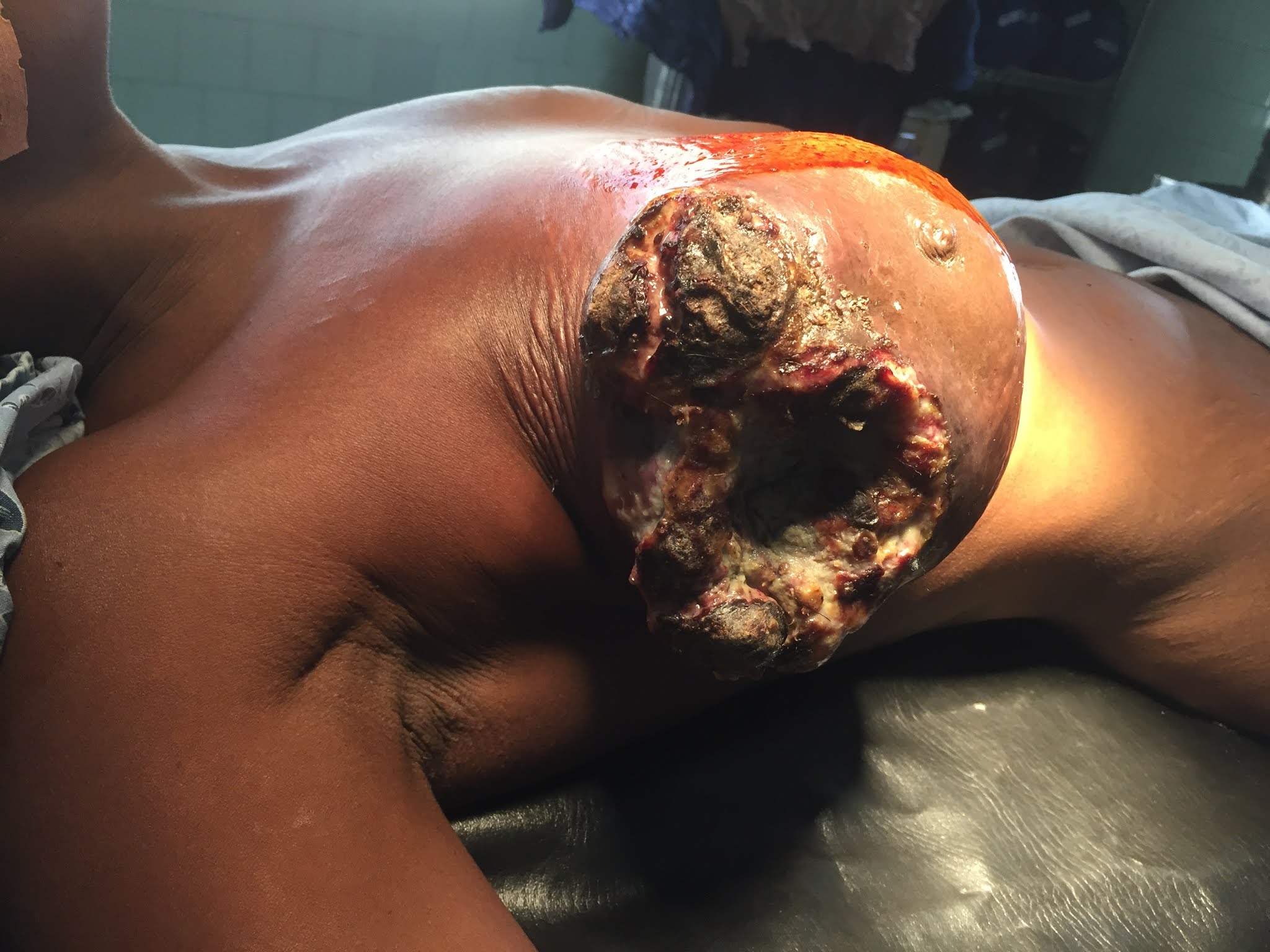
She had a hard mass in her left breast. The tumor was big. Typical of the cancer we see here. There were also nodules under her left axilla (armpit) where cancer had spread to the lymph nodes from the breast. I have seen one single breast cancer patient here without obvious cancer in the axilla, only to find that the  tumor was invading directly into her chest. A different patient had cancer in the axilla that had formed an 8-inch wide fungating ulcer. The smell was so fowl she had to wear a mask for herself.  


This young woman was sad when I explained the prognosis. Chad has no chemotherapy or radiation. It is simply not an option. She and her loving husband decided to have surgery in an effort to prolong her life. Surgery also reduces the risk of horrible ulcerated tumors people live with here. We removed her left breast and lymph nodes. She stayed in the hospital until the incision was well-healed. I advised her small family that they must treasure every moment they have together now. They were grateful for the diagnosis and advice.


Breast cancer here is discouraging. It is one of the many unpleasant realities we face. I dream of screening programs. I have to remind myself that although a lot of things I do are palliative, we are still relieving suffering.  


Photos:

We see horribly advanced breast cancers. The woman in this young family photo had a mastectomy for breast cancer. Additional photos are of other cancers ranging from large tumors, to ulcerations and frank tissue necrosis.


Francais:

Patients viennent avec cancer du sein horrible. La femme ici avec sa jeune famille a subi une mastectomie pour un cancer du sein. Les autres photos sont des grands cancers, ulcérations, et nécroses. 


Español:

Pacientes vengan con cánceres terribles de la mama. La mujer aquí con su familia se sometió a una mastectomía para un cáncer de la mama. Las otras fotos son de canceres grandes, ulceraciones y necrosis. 


Sunday, July 19, 2020

Chadian Massive Transfusion Protocol


At midnight the phone rang. “A woman who just gave birth is bleeding a lot.” 

In the OR Staci was performing a curettage to make sure no pieces of placenta were causing the problem. Medications oxytocin and methergine were in. Staci had also verified there were no major lacerations in the birth canal. We then quickly packed the uterus with gauze in an attempt to stop the hemorrhage. This woman had been laboring for days at home after her water broke. Her inflamed uterus was not clamping down like it should. Phillipe, our nurse who performs anesthesia, was infusing another bag of blood. 

Something drew my attention. It was the pulse on the oxygen sensor. Her heart rate was 170 beats per minute. My heart sank. Was that real? The last blood pressure (BP) reading was 80/50, was that heart rate true? It was ominous. The BP cuff finished cycling: 60/30. Her life at its end flashed before my eyes. Within minutes she would be dead. 

The blood was already pouring out in spite of the gauze packing. I asked Phillipe to run 2 bags of blood at the same time. “We’re doing a hysterectomy.” Opened the kit, threw betadine on her abdomen and began cutting. Her blood pressure was not measurable now. Quick clamp cut tie, clamp cut tie. “Please give more blood, yes, MORE blood!” Phillipe ran to the refrigerator again. Her blood pressure intermittently read at 50/30 when the machine would pick it up. Final clamp, cut, uterus out. Ahhhh, breathe…. bleeding stopped. 

The transfusion total was 9 units of blood.  

The husband was more educated than many of our patients. He was overjoyed when he heard his wife was alive. He understood we had to take out the uterus and said, “Whatever it took to save her, thank you.” 

Walking back to our house in the dark morning hours a flood of emotion overtook me. Her life, falling precipitously, was caught just in time. She is alive. People like the Netteburgs, by their sweat and tears, have developed the only blood bank in this part of the country. People hate donating blood here because it diminishes their “force” to work in the fields. However, every elective surgery patient must have a family member donate a unit of blood. We explain that if the patient needs it during surgery then we give it. If it is not needed during the surgery, we use it for emergencies.

Consequently, every hernia we’ve worked hard to repair this month was another life-saving unit of blood. The cost of generators, fuel, and the mechanic to keep electricity working (most of the time) is beyond what most hospitals in Chad can afford. We have the luxury of keeping our blood bank refrigerator running. 

Our transfusion protocol includes a built-in 1:1:1 ratio of red blood cells, platelets, and plasma. This has been shown to reduce hemorrhage in numerous trauma studies. Even many rural trauma centers in the US have not yet achieved this goal. We don’t separate the components. Consequently, all of it is whole blood, and that’s what we give. 


This woman will raise her kids. People are not surprised when a mother dies in childbirth here. It is so common. Many children grow up without the mother they lost in childbirth. Not for this family though. She is alive! 


Saturday, July 11, 2020

COVID hits Chad


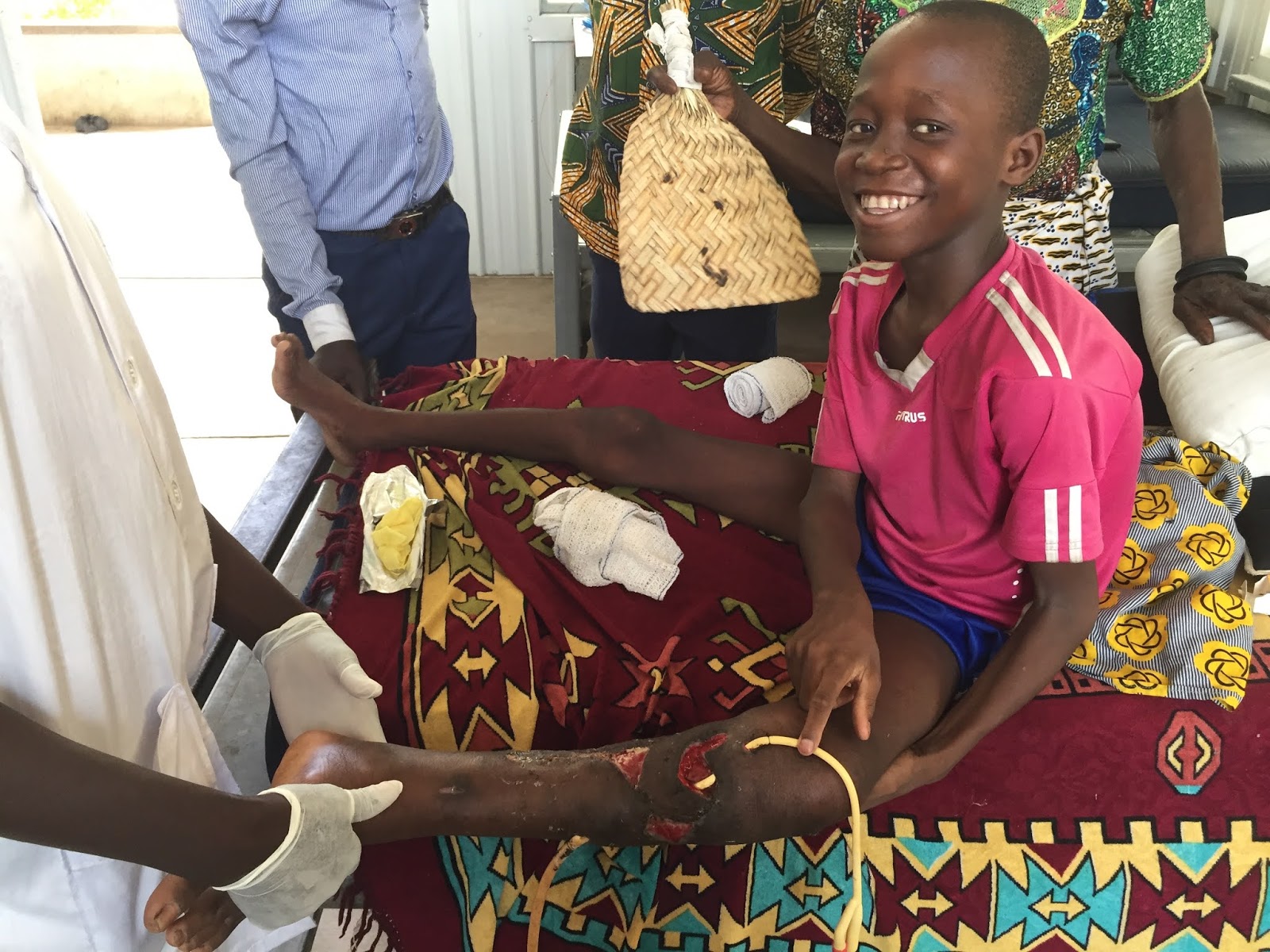
Ricky was coughing and breathing hard. He was a small 12-year-old boy with grey fluid and pieces of necrotic tissue draining from holes on his leg. I took Ricky to the OR, explaining to the family that he may lose his leg. The infected tissue encased his tibia from just below the knee down to the mid shin. 

On the OR table his oxygen saturation was 60%.  He was coughing and taking each rapid breath with difficulty. We have no ventilators and not even oxygen. We performed the operation with only local anesthesia due to the risk that Ketamine would worsen his respiratory status. It was painful for both of us. I removed the infected tissue, and left the skin open to change the gauze dressings in the wound daily. He also developed other abscesses in other parts of his body the subsequent week. 

With antibiotics and excruciating dressing changes, the infections began to clear. We now had a segment of exposed bone needing tissue coverage. Dr. Bill Rhodes, a plastic surgeon with 25 years experience in Kenya, graciously mentored me via WhatsApp on performing a saphenous fasciocutaneous flap to cover the bone. He prayed for me too. I’m indebted to him.  Ricky’s leg is healing wonderfully now. 

We will likely never know if Ricky had COVID-19 and consequently became more susceptible to infections, or if his respiratory symptoms were simply from the bacterial infection with resultant sepsis. We have no tests for coronavirus in this part of the country. 

The capital has limited testing for COVID-19. Over 800 patients have tested positive so far. Close to 10% have died. Chad has 15 million people and only a handful of ventilators. There is no capacity to manage critically ill patients here, even if they were spread out over a 6-month period. In spite of this, the country has prohibited all transport and non-food commerce since March. For the many people who eat by what they have sold at the market that day, the economic consequences are devastating. Our patients tell us that in the nearby city of Kelo, there are children crying on the street in hunger. Hunger is a serious problem at baseline in Chad which shutting down the economy has only exacerbated. 

We have a nutrition center to help combat hunger. A potentially more challenging problem however, is how to treat the surgical diseases that cut short or handicap many people’s livelihoods.

The city of Kelo is the commerce center for our district. It is 2 hours away by motorcycle and located on the main route linking the capital from Moundou, second largest city. This whole district, including Kelo, at the moment has only 1 trained general surgeon. Our hospital serves a population of approximately 100,000 villagers in its local district which does not include Kelo. However, we are the primary surgical center for Kelo. In addition, patients regularly come to our hospital from all over the country and surrounding countries. 

A physician in the district hospital of Kelo sent a patient to me to re-open after he had performed a laparotomy that day. He did not feel comfortable managing an intestinal stricture. It was apparent that he had performed a lysis of adhesions and was concerned about a part of the bowel that had become narrow from the compression of an adhesive band. However, the band had been cut and the narrow area would now dilate to allow normal intestinal transit. I closed the patient, reassuring the family and the physician in Kelo that he should have normal intestinal function within a few days. The patient did great. 

Another patient arrived from Kelo because there was no one perform his surgery there that week. He had a distended, hard, abdomen. He had suffered from abdominal pain for 5 days. He took his last agonal breath as I entered the emergency room to see him. I screamed with emotion asking why he had not come earlier. They said, “It’s God’s will that he died.” From a throat tight from crying I said, “NO! It’s God’s will that he could receive life-saving surgery earlier.” 

Then there is Ricky, and many others like him who are alive and walking because they came to our hospital. We do not lack patients. They crowd outside the OR. When I leave to see patients on the ward, or to try to go home they call out to me. It is exhausting. In a couple years we will have enough surgeons to start a top knife surgical training program. This will begin to beat back the onslaught of suffering we face daily. There will be so many more boys like Ricky, smiling as they walk. 

(Written in May 2020)


Sunday, July 5, 2020

Morning Run

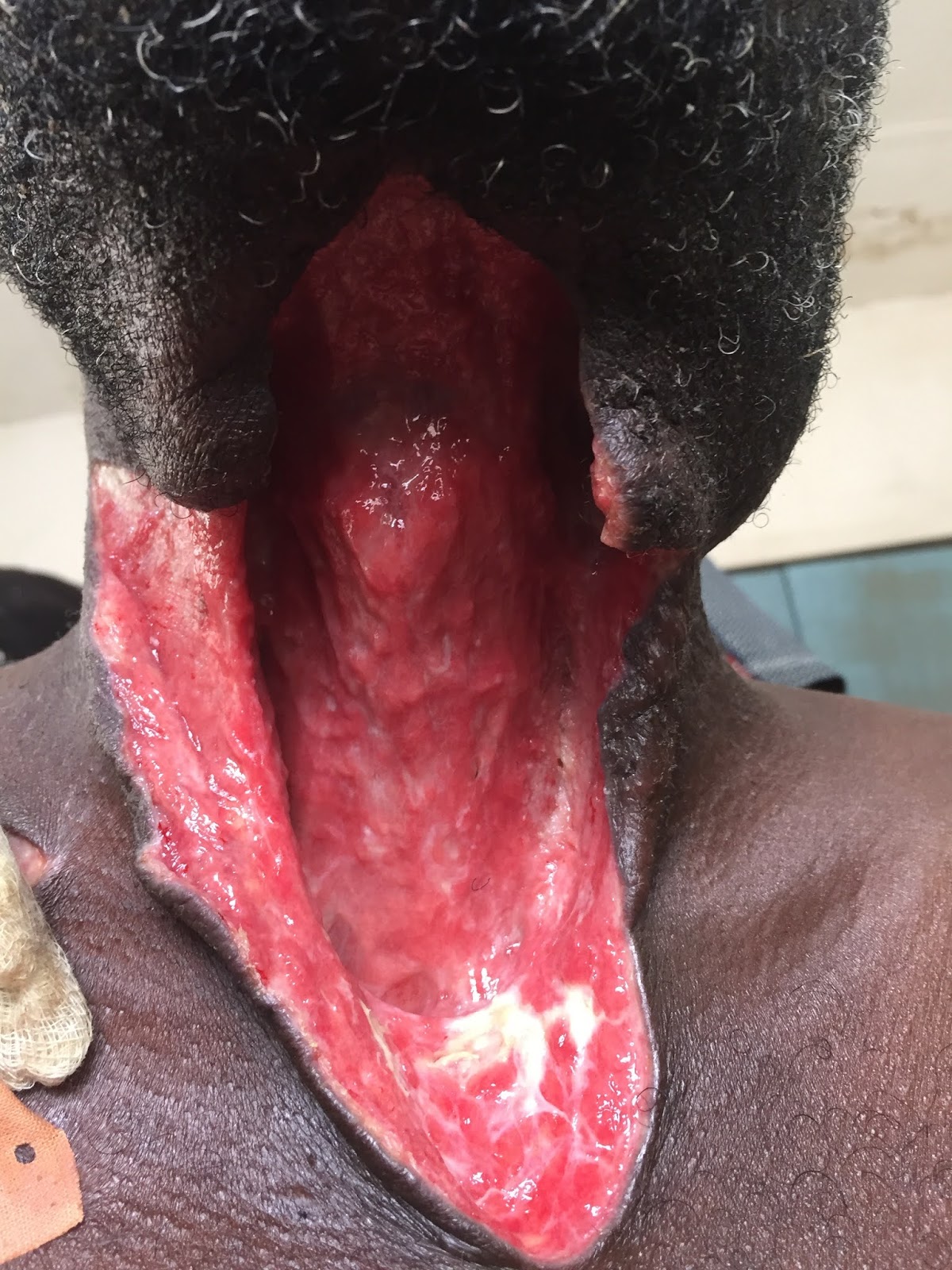
Andrew went for a run this morning and was surprised to see his patient also out for a morning walk. This patient came in about 6 weeks ago with a dental abscess with necrotizing infection of the neck extending to the mediastinum and chest wall. His prognosis was very grim. Thanks to God and to debridement, wound care, and antibiotics, this patient is still alive and doing very well.


Here are some pictures of how his treatment progressed:

This was at his original debridement. 

The debridement went all the way to the trachea. We don’t have ventilators here, so we were concerned that if the infection spread further it could be disastrous.  Here is two weeks later—after more debridement and aggressive dressing changes.


Two weeks later, after more wound care and smaller debridements, the wound was ready to close.